
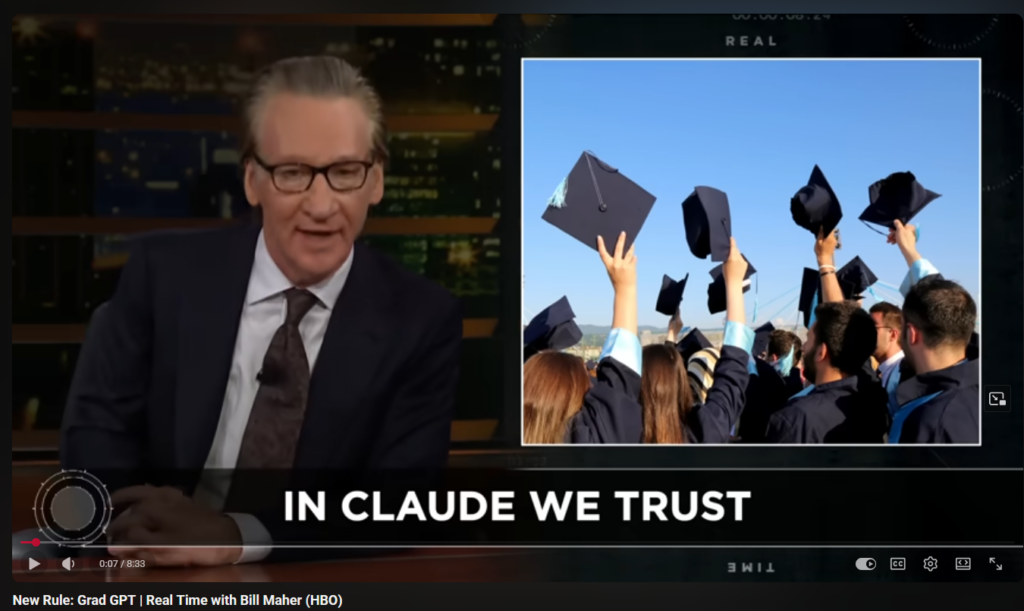
Bill Maher spent a few minutes at the end of a recent Real Time wrapping a genuinely uncomfortable truth in enough humor that people laugh before they realize they’ve agreed to something hard. The subject was this year’s commencement season, the AI-related booing at higher education institutions across the country, and what it actually means that a generation of newly minted degree holders is that angry.
He’s onto something. And it goes deeper than the jokes.
The Anger Is Earned
The students booing are not wrong to be angry. They were told a story in school: work hard, get good grades, go to college, earn a degree. Then they will be competitive in a workplace that rewards specialized academic knowledge. That story came from parents, counselors, and the culture at large. It was presented as settled truth.
It wasn’t fully true then. And it’s exponentially less true now.
The data on this has been accumulating for years. Only about 35 percent of graduates end up working in their field of study. Student debt has ballooned to crisis proportions. Six hundred professors from California recently signed a letter describing college students who arrive unable to perform middle school math. Something in the pipeline was already broken long before anyone had heard of ChatGPT.
What Higher Education Drifted Toward
The honest conversation about higher education, one that’s been avoided for too long, is about what universities actually became over the past few decades. The original mission was grounded in the transmission of knowledge and the cultivation of rigorous thinking. What happened over time was a drift: toward increasingly specialized academic disciplines with limited commercial applicability, toward a culture of credentialism that valued the credential over the competency, and in many cases toward a preoccupation with frameworks and causes at the expense of practical skill development.
None of this is the students’ fault. They enrolled in the system they were handed. The system told them the investment would pay off. For a lot of them, it hasn’t. The gap between the promise and the reality has been widening for a long time.
AI didn’t create this problem. But it put a floodlight on it and compressed the timeline for reckoning by about twenty years.
The Acceleration
When a first-year student can ask an AI to explain any concept in any discipline, with depth, nuance, and patience, for free, at 2 AM, with no judgment, a significant part of the traditional university value proposition evaporates. The knowledge transfer function, the “we will expose you to ideas and information you couldn’t access otherwise” part, is largely gone.
The workforce is feeling this simultaneously. The specialized academic skills that were supposed to command a premium in the job market are precisely the skills being commoditized fastest. English majors learned to write; AI can write. CS majors learned to code; AI can code. Even the narrow career path of academic expertise is narrowing. If AI can synthesize research and generate analysis at scale, the long-term need for professors in purely theoretical disciplines starts to look very different.
What does that leave?
What’s Actually Left, and Why It Matters
Here’s where the conversation has to turn, because there is still something real and irreplaceable here.
What universities can offer that AI genuinely cannot is the experience of being in proximity with other developing human minds. That includes the friction, the collaboration, the mentorship, the live negotiation of ideas across different perspectives. Critical thinking developed under real stakes. Communication built through actual human interaction. The kind of judgment that comes from navigating ambiguity with consequences attached.
And, critically, the ability to work with AI effectively. To know when to use it, how to direct it, how to evaluate what it produces, and where human judgment has to override it. AI literacy is not a technical skill. It is a thinking skill. And it is absolutely learnable.
These are what higher education needs to orient around, urgently. Not as a concession to disruption, but as the honest answer to what was always most valuable about the university experience and what has always been hardest to replicate anywhere else.
What Students and Institutions Need to Do Next
The students who will thrive in the next decade are not the ones who reject AI out of wounded pride or understandable fear. They are the ones who decide, quickly, that they are the AI generation. That means learning to use these tools better than anyone who came before them, while developing the distinctly human capabilities that make those tools worth directing.
Maher made a point that deserves more attention than it got: unlike virtually every other generational challenge, Vietnam, civil rights, this one doesn’t require convincing the older generation to act. The students who are angry about what AI is doing to their career prospects are also the ones best positioned to shape how AI gets integrated into the workforce. That’s unusual leverage, and it deserves a better response than booing.
That transition requires institutions to change faster than most institutions like to change. It means curricula built around adaptability, applied thinking, and real-world problem-solving rather than academic performance metrics designed for a different era. It means being honest with incoming students about what a degree actually delivers and redesigning the experience around what remains genuinely valuable.
There are people doing this work. Angie Carel is one of them, working directly with universities to help them understand what it means to prepare graduates for a post-AI world. Not fighting the disruption, but building the bridge through it. That work is hard, unglamorous, and exactly what’s needed.
A Final Word to the Graduates
You were made promises that the system wasn’t positioned to keep, and the arrival of AI has made the shortfall impossible to ignore. That’s a real grievance, and it deserves to be named honestly.
But the genie is not going back in the bottle. The question now is not whether AI changes the game. It already has. The question is whether you are going to be the generation that learns to play it better than anyone before you. The tools exist. The need is urgent. And unlike most of the big problems facing your generation, this one is entirely yours to solve.
That’s not a consolation prize. That’s a remarkable position to be in.
Howard Booth is the founder of Intellevate Solutions.
Leave a Reply