
How it Often Begins
Most technology adoption doesn’t begin with a grand enterprise plan like an AI roadmap for small business. It starts with enthusiasm. A few forward-thinking team members experiment with a new tool. Than a department leader sees an opportunity to automate part of a workflow. Someone signs up for a pilot. Another group explores a different platform entirely. Progress is happening, but it’s happening in parallel.
At first, it feels innovative and agile. Over time, however, patterns begin to emerge. Teams are using different tools to solve similar problems. Licenses overlap. Data is flowing into systems that were never vetted centrally. Policies either don’t exist or haven’t kept pace. There’s no shared understanding of what the end state should look like. Now introduce AI into that environment.
AI is not simply another piece of software. It touches decision-making, content generation, analytics, customer experience, and intellectual property. It moves quickly, learns, and scales. And once it becomes embedded in daily workflows, it’s difficult to unwind.
None of this means organizations should slow down innovation or stifle early adopters. In fact, that curiosity and initiative are healthy signs. But without a clear roadmap, AI implementation can drift into fragmentation. And the cleanup phase, where leadership must normalize tools, address security gaps, and rein in out-of-bounds use, is always more complicated than getting alignment at the outset.
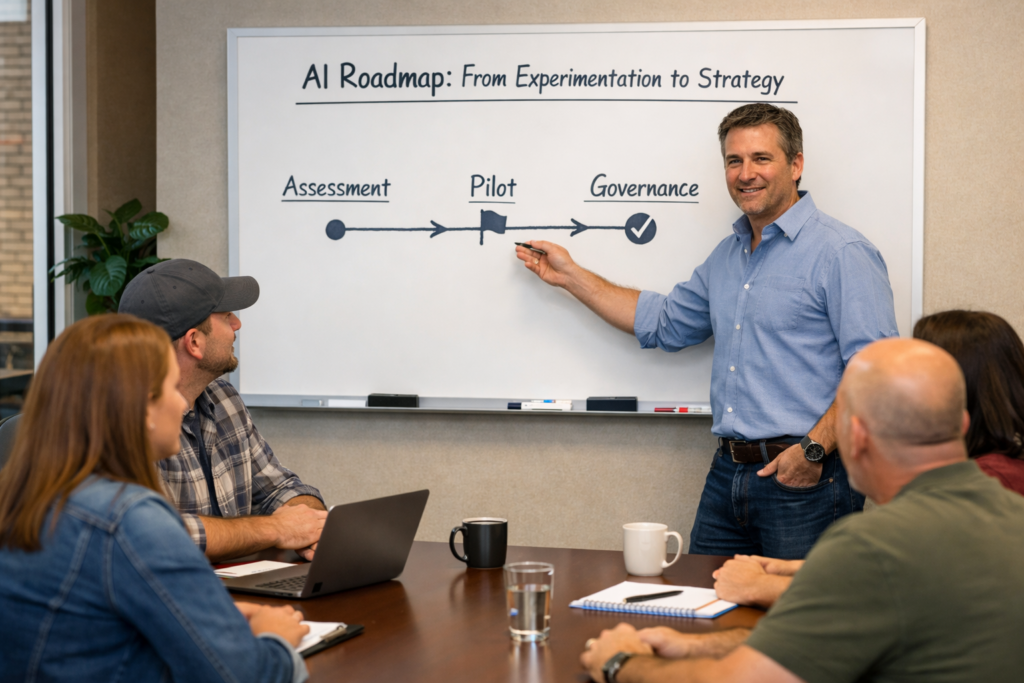
Introducing an AI Roadmap for Small Business
A roadmap does not have to be rigid or overly bureaucratic. In a rapidly evolving space, flexibility is essential. What a roadmap does provide is intention, and clarifies what problems the organization is truly trying to solve. It defines acceptable platforms and guardrails, and establishes ownership for governance and accountability. It sketches a realistic path from today’s experimentation to tomorrow’s integrated, enterprise-wide capability.
Perhaps most importantly, it sets expectations. It signals to the organization that AI adoption will be encouraged, but it will also be deliberate. There may be moments that require patience while policies are drafted, security standards are reviewed, and integration questions are answered. That pause is not resistance. It is stewardship.
By getting in front of AI deployment with a shared vision, companies avoid the costly rework that follows uncontrolled expansion. They reduce redundant spend, and protect sensitive data. The roadmap can make solutions transferable across departments instead of siloed within them. And they ensure that technology serves strategy, not the other way around.
The Vision
AI will continue to find its way into the workplace. The real question is whether it will do so organically and unevenly, or intentionally and cohesively. A thoughtful roadmap does not slow momentum. It channels it. And in a space moving as quickly as AI, direction matters more than speed.
We invite you to sit down with us to outline what a AI roadmap for small business could look like. A brief, painless conversation is all it takes to set the foundation, making follow-up steps far easier to take.
Leave a Reply