
Overview of Robotic Process Automation
At Intellevate, our roots are deeply embedded in the Robotic Process Automation (RPA) revolution. Our RPA journey began over a decade ago. Intellevate’s founding team cut their teeth in the early days of RPA. Our extensive experience in IT consulting and automation has matured alongside it. We now leverage advanced technologies like Agentic AI that fuse RPA with AI. However, traditional RPA remains the foundation of practical business automation. For well-defined, repetitive processes, RPA remains unparalleled in efficiency. This core service offering is as relevant today as ever, and we encourage businesses to explore how RPA can transform their operations.
While the term “Robotic” in Robotic Process Automation (RPA) may evoke images of physical robots, in reality it refers entirely to digital, software-based bots. These “soft robots” operate within IT systems, emulating human actions within digital systems. For example, bots can log in to applications, enter data, and perform calculations. They complete these tasks faster and without errors. At Intellevate, we rely on leading RPA platforms to implement these solutions. We are a proud partner of UiPath, a robust and scalable enterprise-grade RPA tool. In addition, we frequently implement Microsoft Power Automate for clients embedded in the Microsoft ecosystem, as well as other major players like Blue Prism and Automation Anywhere. Modern RPA delivery can also be cloud-based, and SaaS offerings enable rapid deployment. However, on-premises solutions remain an option for certain enterprise requirements.
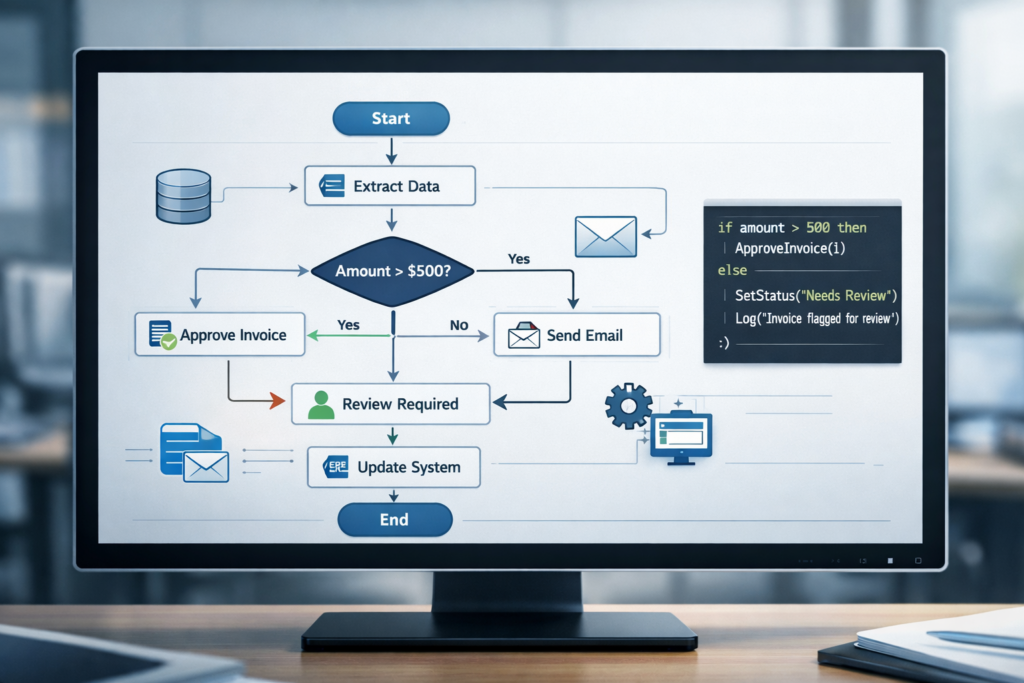
Robotic Process Automation Use Cases
RPA’s is most impactful in data-intensive, mature business functions. In finance, it automates tasks like invoice matching and financial reconciliation. For HR, it accelerates on-boarding and automates leave requests. In IT, it streamlines ticketing and user provisioning. These are just examples, but what ties them together is business process improvement. RPA frequently aligns with Lean Six Sigma principles, identifying process inefficiencies and then using RPA to automate them. By doing so, businesses achieve not only automation but streamlined, optimized processes that yield lasting efficiency gains.
Implementing RPA yields a spectrum of tangible and intangible benefits. On the tangible side, RPA accelerates operations, shortening time-to-market by executing processes faster and around the clock. It enhances customer service by reducing response times, allowing quicker resolution of customer needs. Companies often realize operational efficiencies through reduced manual effort, leading to cost savings. Beyond these, RPA drives softer intangible gains: improved compliance through consistent rule execution, error reduction by eliminating human mistakes, and higher employee satisfaction as tedious tasks are offloaded. All of this contributes to a more agile, accurate, and satisfied organization, even beyond immediate cost and revenue impacts.
Robotic Process Automation Implementation
Our engagement model is designed to meet the customer where they are. First, we begin with strategic consulting. We help businesses understand RPA options, assess their processes, and identify high-impact, high-ROI use cases. Then we move into solution design and delivery, developing and deploying bots that align with business goals. For organizations seeking ongoing governance, we help establish and staff a Center of Excellence. This ensures RPA continues to evolve and deliver value. Whether as an advisory partner or a full-service delivery team, we tailor our involvement to fit each client’s RPA journey.
We invite you to have a straightforward conversation with us, no pressure. We’ll listen to your challenges, help you assess where automation fits (and where it doesn’t), and give you a clear perspective on tools and strategies. Whether you’re exploring automation for the first time or refining your approach, we’ll help you focus on the right opportunities at the right time. When you’re ready, we’ll be here to help you find automation that truly works for you. Let’s start that dialogue.